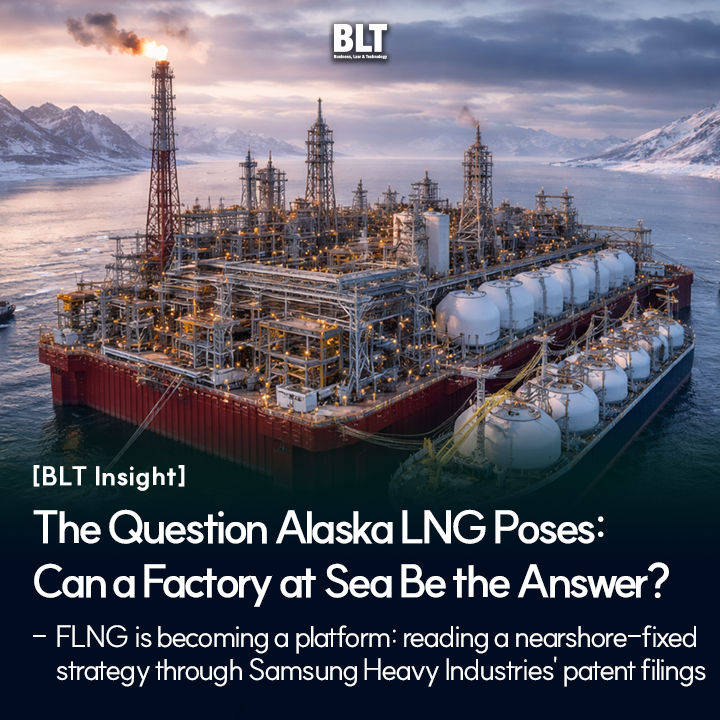
Under the current Trump administration, the idea of developing Alaska's gas has resurfaced repeatedly in U.S. energy and trade policy. What makes it interesting is that the question is not simply how much gas can be extracted. In Alaska, the remoteness of the resource, the difficulty of building infrastructure, long construction schedules, and environmental and permitting hurdles mean that where and how the liquefaction facility is built can decide whether the project succeeds. Turning gas into liquid is the starting point of any long-distance transport system.
Conventionally, an LNG project is built around a large onshore liquefaction plant. But the more burdensome onshore construction becomes, the harder developers look at moving liquefaction offshore. That is where FLNG enters. FLNG — floating liquefied natural gas — is a facility that processes and liquefies gas at sea, stores it as LNG, and offloads it to LNG carriers. It is commonly described as a "factory at sea," but in practice it is closer to an infrastructure package that bundles station-keeping and mooring, operations and maintenance access, power reliability, topsides layout, and fabrication and erection methodology.
One point is worth settling up front. FLNG is not a new concept. Very large projects such as Shell's Prelude already exist, and Eni's Coral Sul has been producing off Mozambique since 2022. Both were built at Samsung Heavy Industries' Geoje yard — Coral Sul by the TJS consortium of Technip Energies, JGC, and Samsung Heavy Industries. So the focus of this column is not whether FLNG is feasible, but what design direction recent filings reveal.
Samsung Heavy Industries' FLNG applications from 2023 and 2024 in particular show a strategy of expanding FLNG from a one-off project into a product family. Two ideas run through them: nearshore-fixed siting, and a repeatable platform approach. Read that way, the Alaska question quickly becomes a question about where FLNG is heading, and about who is in a position to take it there.
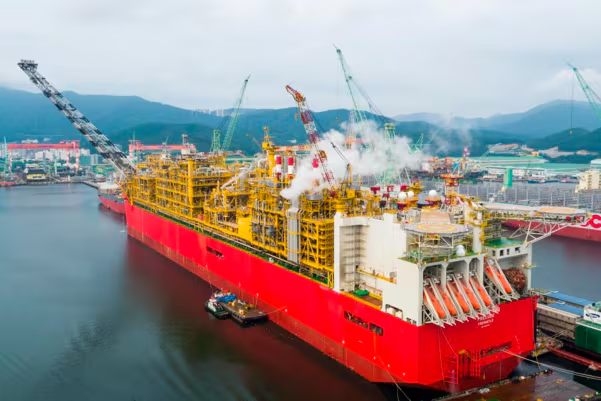
[Shell's Prelude FLNG, the world's largest floating LNG facility, built at Samsung Heavy Industries' Geoje yard]
1. 2023 — The nearshore-fixed answer: making a marine facility a plant you can commute to
The first thread is nearshore-fixed siting. Korean Patent Application No. 10-2023-0056332 ("Nearshore-Fixed Floating LNG Production Facility") captures an idea that goes beyond floating an FLNG in open water: installing it close to shore and changing the operating model itself.
"Fixed" here does not mean it stops floating. The hull stays afloat, but it is held at a fixed site and heading rather than weathervaning via a turret in open water — and that changes what the facility needs on board. The core move is to shrink or eliminate the living quarters and the electrical and instrumentation (E&I) building, the structures a permanently manned offshore facility requires, and to crew the plant from shore instead. The concept is to float it at sea but operate it as though it were onshore. In projects where operating manpower and maintenance access govern cost and availability, that shift goes to the heart of the economics.
2. 2023 — Integration around a utility building: consolidating the plant into a single core structure
KR 10-2023-0056333 ("Nearshore-Fixed Floating LNG Production Facility Having a Utility Building") takes the nearshore-fixed concept a step further, this time on layout. The utility building is a single core structure that consolidates power, control, communications, support systems, and workspace.
An FLNG is more than its topsides — the liquefaction train and the process modules that feed it. It is also the power and control infrastructure that drives them, and the two are tightly interdependent. This thread points toward integrating that complexity at the design stage, lowering the burden not only of construction but of operation, maintenance, and inspection. The larger a project grows, the more a manageable structure becomes as much a source of advantage as the performance of the equipment itself.
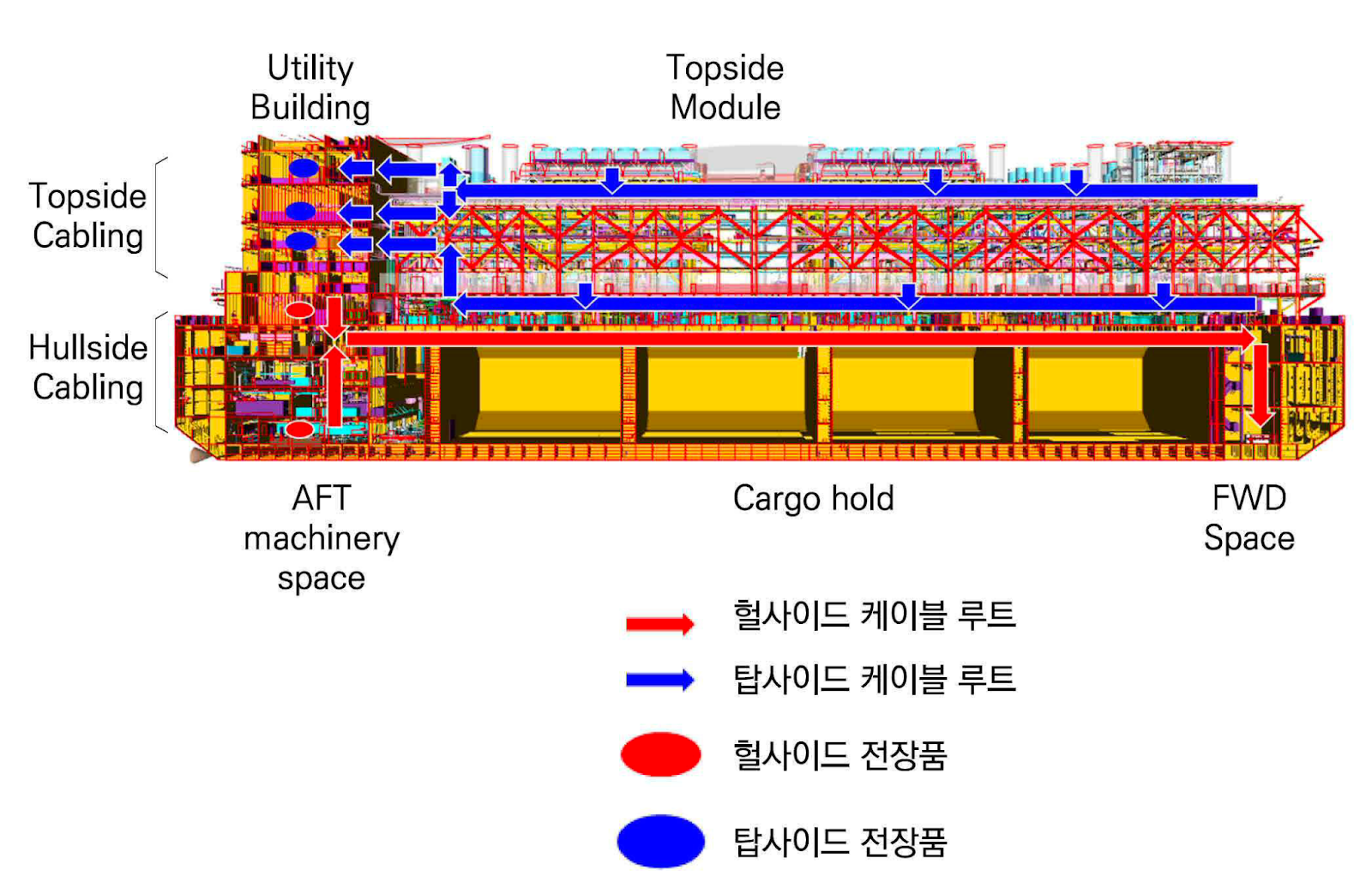
[Configuration drawing including the utility building, KR 10-2023-0056333 (Source: KIPO gazette)]
3. 2023 — Optimizing tank and hull arrangement: asymmetry creates layout flexibility
The third thread concerns the cargo tanks inside the hull and how the hull is arranged around them. An FLNG is not complete with the liquefaction topsides alone. The structure and placement of the cargo tanks that store LNG directly affect hull size, strength, stability, and the flexibility available for the topsides layout.
KR 10-2023-0117184 ("Floating LNG Production Facility Having Asymmetrically Arranged Liquid Domes") proposes placing the liquid domes asymmetrically. A liquid dome is the raised trunk on the tank top through which pumps, piping, and instrumentation penetrate the membrane. The point is not simply to use more space: asymmetric placement reduces clashes between topsides modules, piping, and supporting systems, and opens up layout flexibility, so the plant can be laid out more efficiently. The design therefore targets a specific problem — minimizing layout clashes and using deck space better — rather than a vague goal such as "operational efficiency."
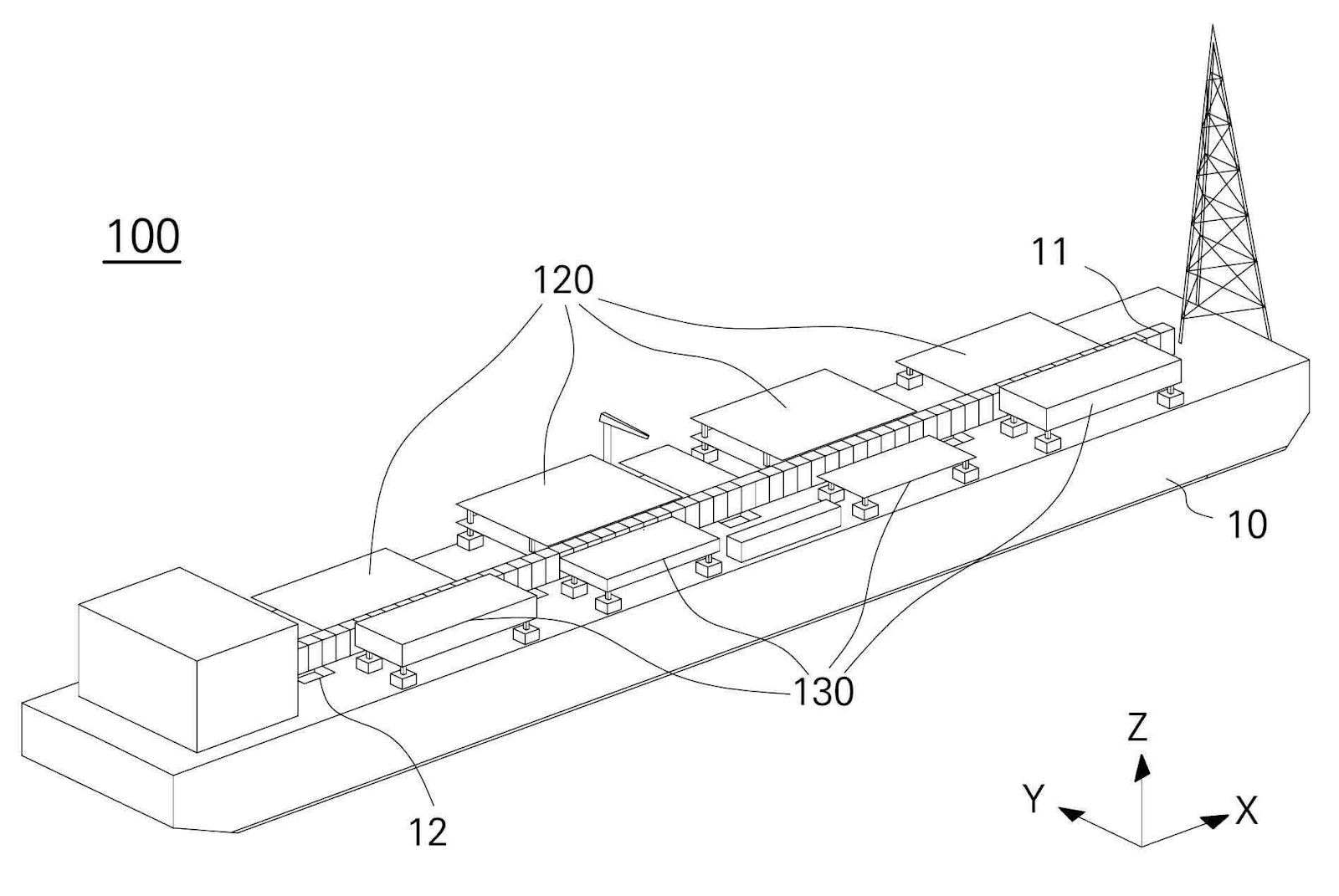
[asymmetric liquid dome arrangement (KR 10-2023-0117184)]
4. 2023 — Locking the construction method into a patent: how do you erect the large blocks?
An FLNG is as difficult to build as it is to design. So the 2023 filings put two questions front and center: how to assemble it, and in what order to erect it. KR 10-2023-0117394 ("Method of Erecting Double-Deck Blocks Above a Large LNG Tank in a Nearshore-Fixed FLNG") addresses exactly that. In plain terms, it turns the build into a recipe: how the structure should be broken into pre-outfitted blocks, what temporary supports to use, and in what order the pieces go into place.
Why method filings like this matter is straightforward. In FLNG, experience compounds: the yard that has built the most carries the fewest unknowns. Prelude and Coral Sul both came out of the same Geoje yard, and a filing of this kind is what turns that record into transferable, protectable process knowledge. The more repeatable the process and the more standardized the erection sequence, the tighter the schedule and cost variance. In a project like Alaska, where overall risk turns on the difficulty of building the infrastructure, standardizing the construction method is at once a technical and a commercial question.
5. 2024 — Platformization and power self-sufficiency: turning FLNG into a repeatable product line
Two applications from 2024 show the direction of this group most clearly.
KR 10-2024-0056123 ("Nearshore-Fixed FLNG Having a Cargo Hold of Defined Breadth and Depth, and Method of Designing the Same") sets out a design method that treats principal dimensions — the breadth and depth of the cargo hold, the hull compartment that houses the LNG tank — as controlled parameters. It is an attempt to move away from redrawing the design for every project, and instead to build a repeatable design system by managing standard dimensions and compartments. If FLNG is to be seen as infrastructure expandable into a product family rather than a one-off newbuilding, this kind of standardization has to come first.
KR 10-2024-0056129 ("Nearshore-Fixed FLNG Having a Floater Self-Power Supply, and Power Control Method Therefor") puts power front and center. An FLNG consumes a great deal of electricity, and the reliability of that supply translates directly into availability. In remote, high-cost environments especially, fragile power infrastructure becomes an immediate operational risk. What makes this thread significant is that it treats nearshore-fixed siting not as a mere installation method but as a way of engineering operational reliability into the package.
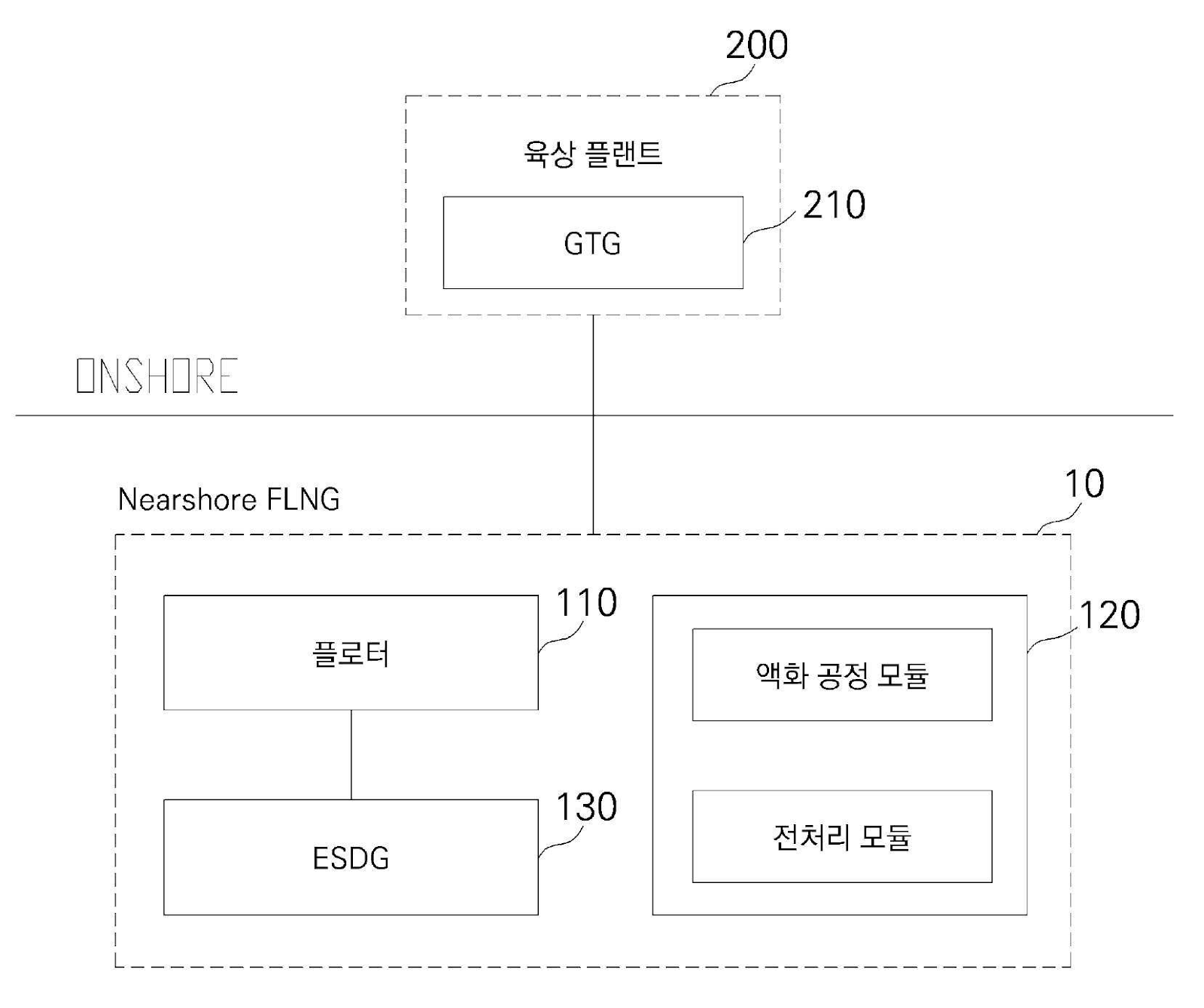
[Block diagram of a nearshore-fixed floating LNG production facility having a floater self-power supply
(Source: KIPO gazette)]
The question Alaska poses is not about gas. It is about the infrastructure package.
The Alaska LNG issue puts a question to Korean shipbuilding that goes well beyond order-book optimism. It is a structural question: what infrastructure package can you present, on what schedule, and at what risk?
FLNG is an important option capable of changing the shape of that package, but it would be wrong to call it the only answer for Alaska. The sharper question is this: when an onshore liquefaction plant becomes burdensome, can a fixed liquefaction package sited close to shore — one that maximizes access and simplifies operations — carry the argument? And can that alternative be standardized and offered as a repeatable product line?
Samsung Heavy Industries' 2023–2024 filings offer one company's answer. The strategy at its core is to make FLNG a standardized package product rather than a project: a nearshore-fixed operating model built around commutable access, integration around a utility building, optimized tank and hull arrangement, a large-block erection methodology, design standardization, and power self-sufficiency. The factory at sea is evolving — not by accumulating individual technologies, but by becoming an infrastructure package designed to be sold over and over. The Alaska question is the catalyst for a new kind of competition: package against package. And Samsung Heavy Industries' filings show that blueprint in its sharpest form.
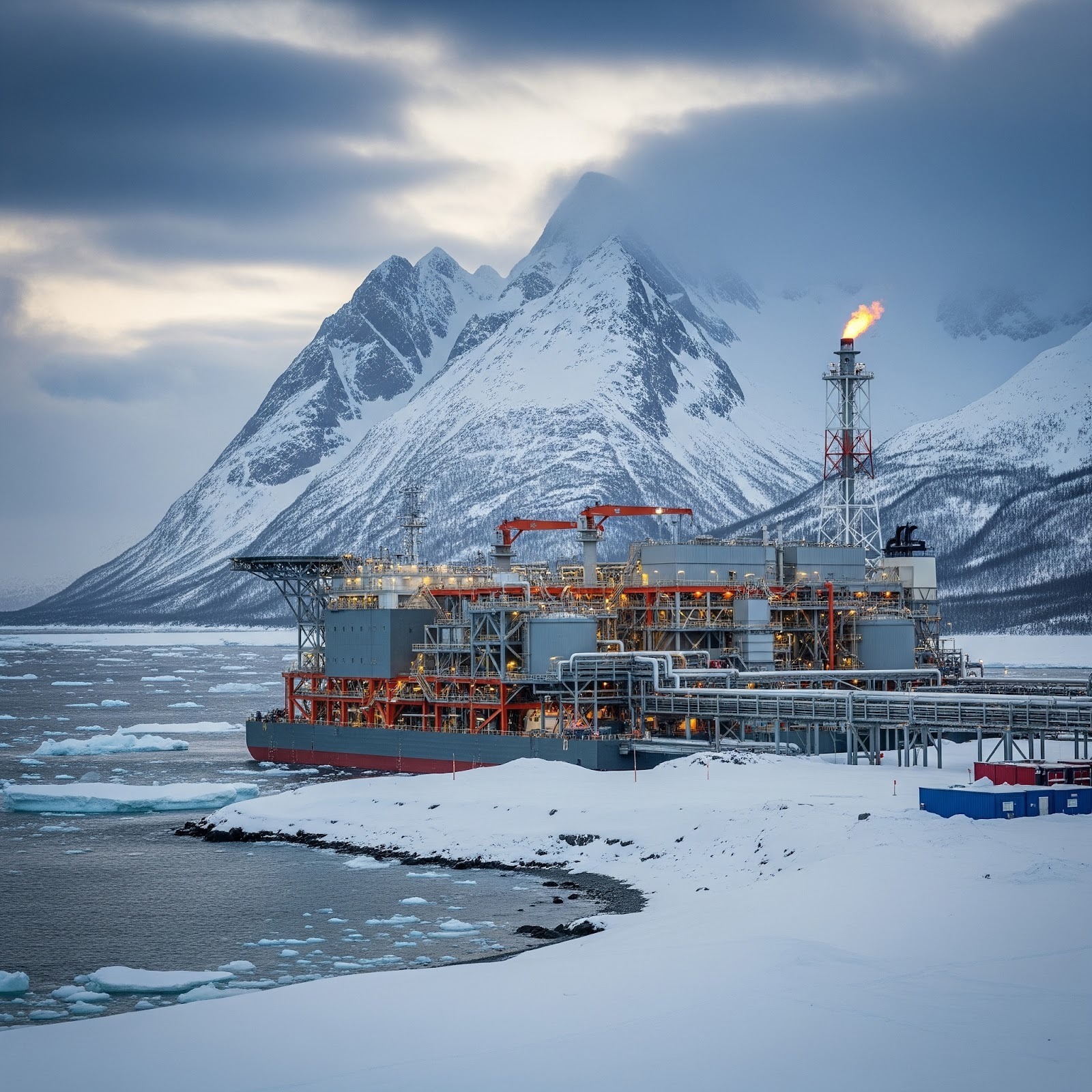
[AI-generated image of an FLNG installed in polar waters]
The less settled a project is — and Alaska LNG has yet to take a final investment decision (FID) — the more the outcome turns on the persuasiveness of the infrastructure package. Together with the American shipbuilding and maritime infrastructure revival symbolized by MASGA — Make American Shipbuilding Great Again, the Korea–U.S. shipbuilding cooperation package — this may be the moment Korean shipbuilding moves from supplying LNG carriers to selling offshore plants, modules, and operating systems as a single package.
By Taekyun Chung
Patent Attorney, BLT Patent & law Firm
#FLNG #FloatingLNG #NearshoreFixed #FactoryAtSea #AlaskaLNG #AlaskaGas #SamsungHeavyIndustries #OffshorePlant #Shipbuilding #LNGProjects #GasLiquefaction #LiquefactionTrain #InfrastructurePackage #ModularDesign #Topsides #CargoContainment #UtilityBuilding #BlockErection #Standardization #FID #MASGA #EnergyInfrastructure #PatentStrategy #IPStrategy #PatentAnalysis #KoreanShipbuilding #KoreanIPFirm #BLT





Under the current Trump administration, the idea of developing Alaska's gas has resurfaced repeatedly in U.S. energy and trade policy. What makes it interesting is that the question is not simply how much gas can be extracted. In Alaska, the remoteness of the resource, the difficulty of building infrastructure, long construction schedules, and environmental and permitting hurdles mean that where and how the liquefaction facility is built can decide whether the project succeeds. Turning gas into liquid is the starting point of any long-distance transport system.
Conventionally, an LNG project is built around a large onshore liquefaction plant. But the more burdensome onshore construction becomes, the harder developers look at moving liquefaction offshore. That is where FLNG enters. FLNG — floating liquefied natural gas — is a facility that processes and liquefies gas at sea, stores it as LNG, and offloads it to LNG carriers. It is commonly described as a "factory at sea," but in practice it is closer to an infrastructure package that bundles station-keeping and mooring, operations and maintenance access, power reliability, topsides layout, and fabrication and erection methodology.
One point is worth settling up front. FLNG is not a new concept. Very large projects such as Shell's Prelude already exist, and Eni's Coral Sul has been producing off Mozambique since 2022. Both were built at Samsung Heavy Industries' Geoje yard — Coral Sul by the TJS consortium of Technip Energies, JGC, and Samsung Heavy Industries. So the focus of this column is not whether FLNG is feasible, but what design direction recent filings reveal.
Samsung Heavy Industries' FLNG applications from 2023 and 2024 in particular show a strategy of expanding FLNG from a one-off project into a product family. Two ideas run through them: nearshore-fixed siting, and a repeatable platform approach. Read that way, the Alaska question quickly becomes a question about where FLNG is heading, and about who is in a position to take it there.

[Shell's Prelude FLNG, the world's largest floating LNG facility, built at Samsung Heavy Industries' Geoje yard]
1. 2023 — The nearshore-fixed answer: making a marine facility a plant you can commute to
The first thread is nearshore-fixed siting. Korean Patent Application No. 10-2023-0056332 ("Nearshore-Fixed Floating LNG Production Facility") captures an idea that goes beyond floating an FLNG in open water: installing it close to shore and changing the operating model itself.
"Fixed" here does not mean it stops floating. The hull stays afloat, but it is held at a fixed site and heading rather than weathervaning via a turret in open water — and that changes what the facility needs on board. The core move is to shrink or eliminate the living quarters and the electrical and instrumentation (E&I) building, the structures a permanently manned offshore facility requires, and to crew the plant from shore instead. The concept is to float it at sea but operate it as though it were onshore. In projects where operating manpower and maintenance access govern cost and availability, that shift goes to the heart of the economics.
2. 2023 — Integration around a utility building: consolidating the plant into a single core structure
KR 10-2023-0056333 ("Nearshore-Fixed Floating LNG Production Facility Having a Utility Building") takes the nearshore-fixed concept a step further, this time on layout. The utility building is a single core structure that consolidates power, control, communications, support systems, and workspace.
An FLNG is more than its topsides — the liquefaction train and the process modules that feed it. It is also the power and control infrastructure that drives them, and the two are tightly interdependent. This thread points toward integrating that complexity at the design stage, lowering the burden not only of construction but of operation, maintenance, and inspection. The larger a project grows, the more a manageable structure becomes as much a source of advantage as the performance of the equipment itself.
[Configuration drawing including the utility building, KR 10-2023-0056333 (Source: KIPO gazette)]
3. 2023 — Optimizing tank and hull arrangement: asymmetry creates layout flexibility
The third thread concerns the cargo tanks inside the hull and how the hull is arranged around them. An FLNG is not complete with the liquefaction topsides alone. The structure and placement of the cargo tanks that store LNG directly affect hull size, strength, stability, and the flexibility available for the topsides layout.
KR 10-2023-0117184 ("Floating LNG Production Facility Having Asymmetrically Arranged Liquid Domes") proposes placing the liquid domes asymmetrically. A liquid dome is the raised trunk on the tank top through which pumps, piping, and instrumentation penetrate the membrane. The point is not simply to use more space: asymmetric placement reduces clashes between topsides modules, piping, and supporting systems, and opens up layout flexibility, so the plant can be laid out more efficiently. The design therefore targets a specific problem — minimizing layout clashes and using deck space better — rather than a vague goal such as "operational efficiency."
[asymmetric liquid dome arrangement (KR 10-2023-0117184)]
4. 2023 — Locking the construction method into a patent: how do you erect the large blocks?
An FLNG is as difficult to build as it is to design. So the 2023 filings put two questions front and center: how to assemble it, and in what order to erect it. KR 10-2023-0117394 ("Method of Erecting Double-Deck Blocks Above a Large LNG Tank in a Nearshore-Fixed FLNG") addresses exactly that. In plain terms, it turns the build into a recipe: how the structure should be broken into pre-outfitted blocks, what temporary supports to use, and in what order the pieces go into place.
Why method filings like this matter is straightforward. In FLNG, experience compounds: the yard that has built the most carries the fewest unknowns. Prelude and Coral Sul both came out of the same Geoje yard, and a filing of this kind is what turns that record into transferable, protectable process knowledge. The more repeatable the process and the more standardized the erection sequence, the tighter the schedule and cost variance. In a project like Alaska, where overall risk turns on the difficulty of building the infrastructure, standardizing the construction method is at once a technical and a commercial question.
5. 2024 — Platformization and power self-sufficiency: turning FLNG into a repeatable product line
Two applications from 2024 show the direction of this group most clearly.
KR 10-2024-0056123 ("Nearshore-Fixed FLNG Having a Cargo Hold of Defined Breadth and Depth, and Method of Designing the Same") sets out a design method that treats principal dimensions — the breadth and depth of the cargo hold, the hull compartment that houses the LNG tank — as controlled parameters. It is an attempt to move away from redrawing the design for every project, and instead to build a repeatable design system by managing standard dimensions and compartments. If FLNG is to be seen as infrastructure expandable into a product family rather than a one-off newbuilding, this kind of standardization has to come first.
KR 10-2024-0056129 ("Nearshore-Fixed FLNG Having a Floater Self-Power Supply, and Power Control Method Therefor") puts power front and center. An FLNG consumes a great deal of electricity, and the reliability of that supply translates directly into availability. In remote, high-cost environments especially, fragile power infrastructure becomes an immediate operational risk. What makes this thread significant is that it treats nearshore-fixed siting not as a mere installation method but as a way of engineering operational reliability into the package.
[Block diagram of a nearshore-fixed floating LNG production facility having a floater self-power supply
(Source: KIPO gazette)]
The question Alaska poses is not about gas. It is about the infrastructure package.
The Alaska LNG issue puts a question to Korean shipbuilding that goes well beyond order-book optimism. It is a structural question: what infrastructure package can you present, on what schedule, and at what risk?
FLNG is an important option capable of changing the shape of that package, but it would be wrong to call it the only answer for Alaska. The sharper question is this: when an onshore liquefaction plant becomes burdensome, can a fixed liquefaction package sited close to shore — one that maximizes access and simplifies operations — carry the argument? And can that alternative be standardized and offered as a repeatable product line?
Samsung Heavy Industries' 2023–2024 filings offer one company's answer. The strategy at its core is to make FLNG a standardized package product rather than a project: a nearshore-fixed operating model built around commutable access, integration around a utility building, optimized tank and hull arrangement, a large-block erection methodology, design standardization, and power self-sufficiency. The factory at sea is evolving — not by accumulating individual technologies, but by becoming an infrastructure package designed to be sold over and over. The Alaska question is the catalyst for a new kind of competition: package against package. And Samsung Heavy Industries' filings show that blueprint in its sharpest form.
[AI-generated image of an FLNG installed in polar waters]
The less settled a project is — and Alaska LNG has yet to take a final investment decision (FID) — the more the outcome turns on the persuasiveness of the infrastructure package. Together with the American shipbuilding and maritime infrastructure revival symbolized by MASGA — Make American Shipbuilding Great Again, the Korea–U.S. shipbuilding cooperation package — this may be the moment Korean shipbuilding moves from supplying LNG carriers to selling offshore plants, modules, and operating systems as a single package.
By Taekyun Chung
Patent Attorney, BLT Patent & law Firm
#FLNG #FloatingLNG #NearshoreFixed #FactoryAtSea #AlaskaLNG #AlaskaGas #SamsungHeavyIndustries #OffshorePlant #Shipbuilding #LNGProjects #GasLiquefaction #LiquefactionTrain #InfrastructurePackage #ModularDesign #Topsides #CargoContainment #UtilityBuilding #BlockErection #Standardization #FID #MASGA #EnergyInfrastructure #PatentStrategy #IPStrategy #PatentAnalysis #KoreanShipbuilding #KoreanIPFirm #BLT