Brand builders make the same mistake again and again: they assume that a name everyone already knows will be easy to register. During the trademark examination process, it often works the other way. Fame is not something the examining attorney evaluates, and where the same name is already registered, that registration comes first.
On August 12, 2026, the Trademark Trial and Appeal Board (TTAB) affirmed the examining attorney's refusal to register Serena Williams's SERENA VENTURES under Section 2(d) of the Lanham Act, the likelihood-of-confusion bar. The cited registration was SERENA, owned by VC Management Florida LLC, a Clearwater, Florida company.

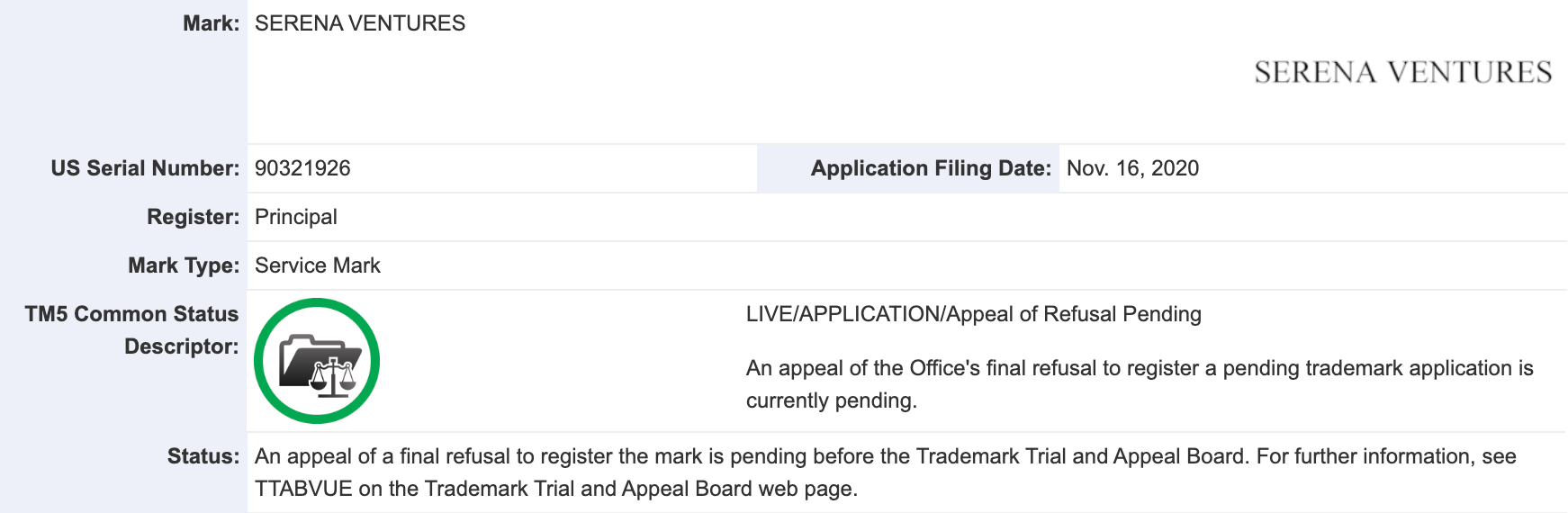
The prosecution record. Five years and nine months passed from filing to decision.
(Source: USPTO TSDR)
The fund was already running before she left the court
Serena Williams won 23 Grand Slam singles titles before leaving the court after the 2022 US Open. Her move into investing, though, did not start with retirement.
Serena Ventures was formed in 2014. It operated in private at first, emerged from stealth mode in 2019, and in 2022 closed its first institutional fund at $111 million. It has since invested in more than 100 companies, 16 of which have passed a $1 billion valuation, and roughly 70% of its portfolio companies are led by women or people of color. This was not a side project carrying an athlete's name. It was a fund with a clear investment thesis.
The trademark application sits in the middle of that trajectory. It states a date of first use anywhere of August 18, 2017, and a date of first use in commerce of December 3, 2018. The name was in use first; the application was not filed until November 16, 2020, after the firm had made its existence public. The recitation of services, in International Class 36, covered investment of funds, venture capital financing, funding for new and start-up businesses, capital investment, and equity investment.
The application did not resolve quickly. During prosecution the SERENA registration was cited and registration was refused; the applicant appealed. The Board's decision came this August, five years and nine months after the filing date.
The interval worth looking at, though, is the earlier one. The name went into use in 2017; the application was filed in 2020. In between, on December 18, 2019, a company in Clearwater, Florida, filed SERENA — covering real estate marketing in Class 35, real estate brokerage, management, financing and investment advisory services in Class 36, and real estate development in Class 37. Serena Ventures filed its own name eleven months later. The trademark registration did not remain vacant, waiting for their application. Build first and file later, and the plan only works if nothing happens in between.
The application carried one more feature. The applicant disclaimed the exclusive right to use VENTURES apart from the mark as shown, because the word is descriptive of the services. A disclaimer does not delete the word from the mark — the Board still compares the marks in their entireties, and simply gives the descriptive portion less weight. But once that weighting is applied, the comparison comes down in substance to SERENA against SERENA. That core comparison effectively determined the outcome of the case.
The prosecution record. Five years and nine months passed from filing to decision.
(Source: USPTO TSDR)
Fame was not a shield before the Board
The applicant argued that SERENA VENTURES carries a "distinct corporate and institutional identity" — that consumers would not confuse a venture capital firm bearing a globally recognized name with a Florida investment company.
The Board took judicial notice that the applicant is a widely known tennis player. Even so, it held that this recognition did not distinguish the two marks in the context of financial services. The Board's finding stood: to consumers, the two marks convey the same connotation and commercial impression — the same overall take-away in appearance, sound, and meaning.
A common misconception surfaces here: that greater fame means less confusion. But the inquiry does not ask whether this person is famous. It asks whether consumers are likely to be confused as to source when this mark is applied to these services. Fame does not attach to a name in the abstract. It attaches to a field. Recognition built in tennis carries weight for tennis equipment. In the context of venture capital, that fame carries little weight when facing a prior registration.
The Examiner Is Strictly Bound by the Written Register
The applicant's second argument is the more practical one. The owner of the cited SERENA registration does business only in Clearwater, Florida, it argued, so the two would never actually collide in the market.
The Board did not accept this. A registration that carries no geographic restriction is presumed to confer exclusive rights nationwide. Unless the registration itself carries such a restriction, where that company actually operates is outside what ex parte examination considers.
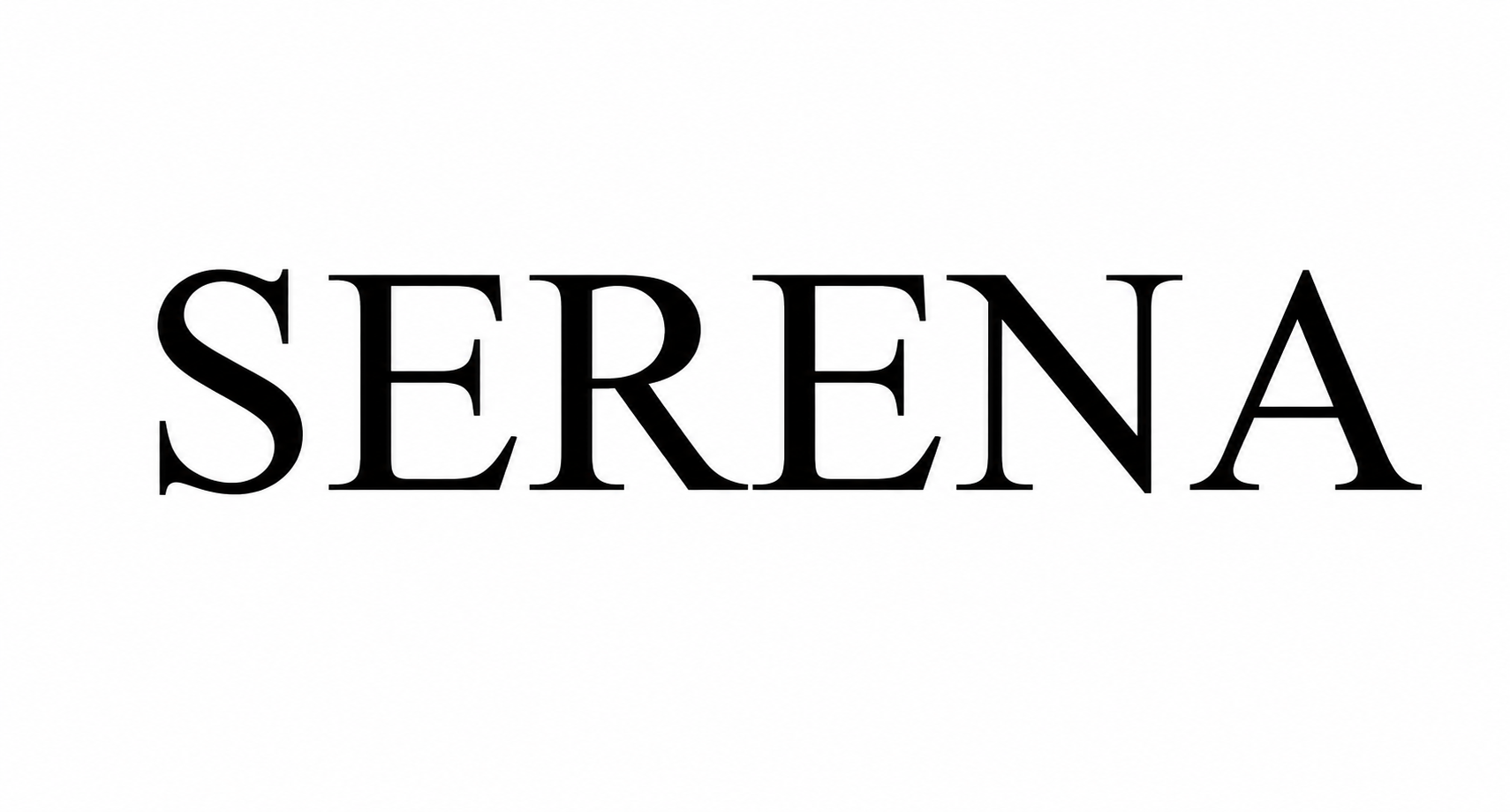 The cited registration SERENA. The owner is a company based in Clearwater, Florida.
(Source: USPTO TSDR)
With both arguments rejected, the outcome followed. Of the DuPont factors — the thirteen-point framework the Board works through in every likelihood-of-confusion case — the first three weighed heavily toward confusion: similarity of the marks, similarity of the services, and similarity of the channels of trade. Only purchaser sophistication tilted the other way, and only slightly; the rest were neutral. The weight of those first three carried the decision.
 A likelihood-of-confusion holding turns on the weight of the factors, not their number.The first three weighed heavily one way;
only purchaser sophistication tilted slightly the other. (Image source: ChatGPT)
The framework behind this holding operates the same way in Korea. Article 34(1)7 of the Korean Trademark Act — the Korean counterpart to a Section 2(d) refusal — bars registration of a mark identical or similar to another party's earlier-filed registered mark, used on identical or similar goods. And the object of comparison is not the business the other side actually operates, but the designated goods and services written in the register, the Korean equivalent of the US identification of goods. A registration exists to the extent of the words on the register, and those words can be broader than the actual scope of the business.
So this standard comes back not only when reading someone else's registration, but when designing your own application. Broadly defining the designated goods expands the scope of protection, but it also increases the risk of overlapping with prior registrations. Write them narrowly and you avoid the collision, but you file again when the business expands. Neither is right in the abstract; in my experience it is a decision to make only after seeing the results of a clearance search — a check of the register for marks that could block you. File broadly out of habit, without searching, and a single item you added can hold up the rest of the application.
The renaming was probably not only about the trademark
The sequence deserves care. On July 31, 2026, Serena Ventures announced that it would change its name to Starfire Ventures — about two weeks before the August 12 decision. The reason the firm gave publicly was not a trademark problem. "I felt like Serena Ventures is great, but I wanted it to be bigger than me," Williams said. "I want it to live on. I want this to be something that people look at years and years from now." It is a decision to move a brand tied to an individual name onto an institutional footing, and a natural move for a firm about to raise a larger fund from institutional investors. No public explanation of the new name's origin has been given; what is known is that the team kept its old shorthand — "we also internally always say 'SV,'" as Williams put it.
Reading this case as "she lost the trademark and changed the name" is therefore not accurate. The renaming was announced before the decision, and the reason the firm cited was a larger purpose. That said, given the timing, it is also hard to conclude the larger purpose was the only factor. An ex parte appeal is decided on the briefs, but the odds are usually legible from the record and the examining attorney's position — and the prospect that an application pursued for nearly six years would not reach registration could well have moved up the decision to shift to a new name. If the larger purpose set the direction, the practical trademark situation likely worked on the timing. There is no basis for asserting what was in anyone's mind, but the fact remains that the two events sat two weeks apart.
Either way, what the case shows is clear. Building a brand on a founder's name hits the same wall twice: once in trademark examination, and again when the business outgrows the founder. Your name is yours. The trademark rights in it belong to whoever registered first.
For founders building a business under their own name
If you are a founder whose name is already known, one point deserves particular attention. Korean trademark law contains a provision — Article 34(1)6, broadly analogous to Section 2(c) of the Lanham Act — barring registration of a mark containing the name of a well-known third party without that person's consent. This is sometimes read as "it is my name, so I am the one who can register it." That provision stops others from registering your name. It does not give you the right to register it yourself. If a prior registration for the same name is already standing there, it stays standing, regardless of the name-protection provision.
Put simply, fame works in two directions. It is genuinely useful in stopping others from registering your name. It cannot be used to push aside someone else's existing registration. Treat those two as the same thing and your launch calendar is resting on an assumption nobody checked.
In Korea too, celebrities and influencers now routinely launch beauty and fashion brands under their own names. In that model, the clearance search usually comes after the name has been chosen. The logo is made, packaging concepts circulate, the launch date is set — and only then is the application prepared, which is when the prior registration is met for the first time. I would reverse the order. The search should generate the candidate names, and the name should be chosen from within that set. Choose the name first and everything else gets built around it — so when the conflict finally surfaces, the name is the one thing still open to change, and by then the most expensive one.
Ask yourself: what name is your brand operating under right now — and was it cleared for registration before the first logo was designed?
By Taekyun Chung
Patent Attorney, BLT Patent & law Firm
#TrademarkRegistration #TrademarkApplication #PriorRegistration #LikelihoodOfConfusion #Section2d #TrademarkRefusal #TTAB #USTrademarks #DuPontFactors #ClearanceSearch #CelebrityBrands #PersonalBrand #InfluencerBrands #BrandNaming #NamingStrategy #Disclaimer #SerenaWilliams #SerenaVentures #StarfireVentures #VentureCapital #KBeauty #KFashion #BrandStrategy #IPStrategy #TrademarkStrategy #KoreanTrademarkAct #KoreanIPFirm #BLT





Brand builders make the same mistake again and again: they assume that a name everyone already knows will be easy to register. During the trademark examination process, it often works the other way. Fame is not something the examining attorney evaluates, and where the same name is already registered, that registration comes first.
On August 12, 2026, the Trademark Trial and Appeal Board (TTAB) affirmed the examining attorney's refusal to register Serena Williams's SERENA VENTURES under Section 2(d) of the Lanham Act, the likelihood-of-confusion bar. The cited registration was SERENA, owned by VC Management Florida LLC, a Clearwater, Florida company.

The prosecution record. Five years and nine months passed from filing to decision.
(Source: USPTO TSDR)
The fund was already running before she left the court
Serena Williams won 23 Grand Slam singles titles before leaving the court after the 2022 US Open. Her move into investing, though, did not start with retirement.
Serena Ventures was formed in 2014. It operated in private at first, emerged from stealth mode in 2019, and in 2022 closed its first institutional fund at $111 million. It has since invested in more than 100 companies, 16 of which have passed a $1 billion valuation, and roughly 70% of its portfolio companies are led by women or people of color. This was not a side project carrying an athlete's name. It was a fund with a clear investment thesis.
The trademark application sits in the middle of that trajectory. It states a date of first use anywhere of August 18, 2017, and a date of first use in commerce of December 3, 2018. The name was in use first; the application was not filed until November 16, 2020, after the firm had made its existence public. The recitation of services, in International Class 36, covered investment of funds, venture capital financing, funding for new and start-up businesses, capital investment, and equity investment.
The application did not resolve quickly. During prosecution the SERENA registration was cited and registration was refused; the applicant appealed. The Board's decision came this August, five years and nine months after the filing date.
The interval worth looking at, though, is the earlier one. The name went into use in 2017; the application was filed in 2020. In between, on December 18, 2019, a company in Clearwater, Florida, filed SERENA — covering real estate marketing in Class 35, real estate brokerage, management, financing and investment advisory services in Class 36, and real estate development in Class 37. Serena Ventures filed its own name eleven months later. The trademark registration did not remain vacant, waiting for their application. Build first and file later, and the plan only works if nothing happens in between.
The application carried one more feature. The applicant disclaimed the exclusive right to use VENTURES apart from the mark as shown, because the word is descriptive of the services. A disclaimer does not delete the word from the mark — the Board still compares the marks in their entireties, and simply gives the descriptive portion less weight. But once that weighting is applied, the comparison comes down in substance to SERENA against SERENA. That core comparison effectively determined the outcome of the case.
The prosecution record. Five years and nine months passed from filing to decision.
(Source: USPTO TSDR)
Fame was not a shield before the Board
The applicant argued that SERENA VENTURES carries a "distinct corporate and institutional identity" — that consumers would not confuse a venture capital firm bearing a globally recognized name with a Florida investment company.
The Board took judicial notice that the applicant is a widely known tennis player. Even so, it held that this recognition did not distinguish the two marks in the context of financial services. The Board's finding stood: to consumers, the two marks convey the same connotation and commercial impression — the same overall take-away in appearance, sound, and meaning.
A common misconception surfaces here: that greater fame means less confusion. But the inquiry does not ask whether this person is famous. It asks whether consumers are likely to be confused as to source when this mark is applied to these services. Fame does not attach to a name in the abstract. It attaches to a field. Recognition built in tennis carries weight for tennis equipment. In the context of venture capital, that fame carries little weight when facing a prior registration.
The Examiner Is Strictly Bound by the Written Register
The applicant's second argument is the more practical one. The owner of the cited SERENA registration does business only in Clearwater, Florida, it argued, so the two would never actually collide in the market.
The Board did not accept this. A registration that carries no geographic restriction is presumed to confer exclusive rights nationwide. Unless the registration itself carries such a restriction, where that company actually operates is outside what ex parte examination considers.
(Source: USPTO TSDR)
With both arguments rejected, the outcome followed. Of the DuPont factors — the thirteen-point framework the Board works through in every likelihood-of-confusion case — the first three weighed heavily toward confusion: similarity of the marks, similarity of the services, and similarity of the channels of trade. Only purchaser sophistication tilted the other way, and only slightly; the rest were neutral. The weight of those first three carried the decision.
only purchaser sophistication tilted slightly the other. (Image source: ChatGPT)
The framework behind this holding operates the same way in Korea. Article 34(1)7 of the Korean Trademark Act — the Korean counterpart to a Section 2(d) refusal — bars registration of a mark identical or similar to another party's earlier-filed registered mark, used on identical or similar goods. And the object of comparison is not the business the other side actually operates, but the designated goods and services written in the register, the Korean equivalent of the US identification of goods. A registration exists to the extent of the words on the register, and those words can be broader than the actual scope of the business.
So this standard comes back not only when reading someone else's registration, but when designing your own application. Broadly defining the designated goods expands the scope of protection, but it also increases the risk of overlapping with prior registrations. Write them narrowly and you avoid the collision, but you file again when the business expands. Neither is right in the abstract; in my experience it is a decision to make only after seeing the results of a clearance search — a check of the register for marks that could block you. File broadly out of habit, without searching, and a single item you added can hold up the rest of the application.
The renaming was probably not only about the trademark
The sequence deserves care. On July 31, 2026, Serena Ventures announced that it would change its name to Starfire Ventures — about two weeks before the August 12 decision. The reason the firm gave publicly was not a trademark problem. "I felt like Serena Ventures is great, but I wanted it to be bigger than me," Williams said. "I want it to live on. I want this to be something that people look at years and years from now." It is a decision to move a brand tied to an individual name onto an institutional footing, and a natural move for a firm about to raise a larger fund from institutional investors. No public explanation of the new name's origin has been given; what is known is that the team kept its old shorthand — "we also internally always say 'SV,'" as Williams put it.
Reading this case as "she lost the trademark and changed the name" is therefore not accurate. The renaming was announced before the decision, and the reason the firm cited was a larger purpose. That said, given the timing, it is also hard to conclude the larger purpose was the only factor. An ex parte appeal is decided on the briefs, but the odds are usually legible from the record and the examining attorney's position — and the prospect that an application pursued for nearly six years would not reach registration could well have moved up the decision to shift to a new name. If the larger purpose set the direction, the practical trademark situation likely worked on the timing. There is no basis for asserting what was in anyone's mind, but the fact remains that the two events sat two weeks apart.
Either way, what the case shows is clear. Building a brand on a founder's name hits the same wall twice: once in trademark examination, and again when the business outgrows the founder. Your name is yours. The trademark rights in it belong to whoever registered first.
For founders building a business under their own name
If you are a founder whose name is already known, one point deserves particular attention. Korean trademark law contains a provision — Article 34(1)6, broadly analogous to Section 2(c) of the Lanham Act — barring registration of a mark containing the name of a well-known third party without that person's consent. This is sometimes read as "it is my name, so I am the one who can register it." That provision stops others from registering your name. It does not give you the right to register it yourself. If a prior registration for the same name is already standing there, it stays standing, regardless of the name-protection provision.
Put simply, fame works in two directions. It is genuinely useful in stopping others from registering your name. It cannot be used to push aside someone else's existing registration. Treat those two as the same thing and your launch calendar is resting on an assumption nobody checked.
In Korea too, celebrities and influencers now routinely launch beauty and fashion brands under their own names. In that model, the clearance search usually comes after the name has been chosen. The logo is made, packaging concepts circulate, the launch date is set — and only then is the application prepared, which is when the prior registration is met for the first time. I would reverse the order. The search should generate the candidate names, and the name should be chosen from within that set. Choose the name first and everything else gets built around it — so when the conflict finally surfaces, the name is the one thing still open to change, and by then the most expensive one.
Ask yourself: what name is your brand operating under right now — and was it cleared for registration before the first logo was designed?
By Taekyun Chung
Patent Attorney, BLT Patent & law Firm
#TrademarkRegistration #TrademarkApplication #PriorRegistration #LikelihoodOfConfusion #Section2d #TrademarkRefusal #TTAB #USTrademarks #DuPontFactors #ClearanceSearch #CelebrityBrands #PersonalBrand #InfluencerBrands #BrandNaming #NamingStrategy #Disclaimer #SerenaWilliams #SerenaVentures #StarfireVentures #VentureCapital #KBeauty #KFashion #BrandStrategy #IPStrategy #TrademarkStrategy #KoreanTrademarkAct #KoreanIPFirm #BLT