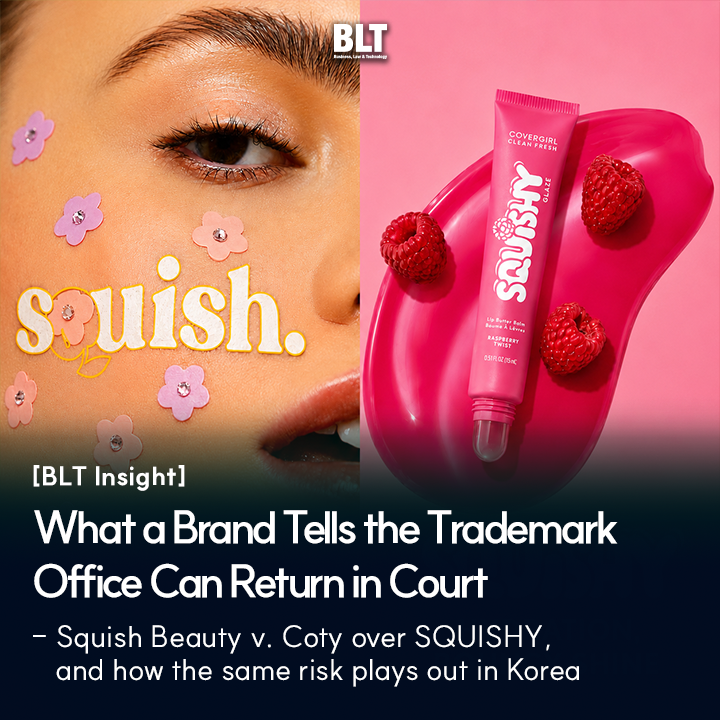
When Korea's Ministry of Intellectual Property (MOIP, formerly the Korean Intellectual Property Office) refuses a trademark application over an earlier registration, it does so under Article 34(1)7 of the Korean Trademark Act, broadly the Korean counterpart to a Section 2(d) refusal. The usual response is a written argument that the two marks differ in appearance, pronunciation, and meaning. Once the registration issues, most brand owners treat that argument as a closed matter. A trademark lawsuit now pending in New York shows how such statements can return when the same brand later tries to stop a similar name. Brands registering their names in Korea face the same risk.
Squish obtained its SQUISH registration over a prior SQUISHY registration
Squish Beauty is an independent beauty brand founded in 2019 by the model Charli Howard. Based in Brooklyn, it has built a following on social media with playful products such as jelly lip gloss and flower-shaped acne patches. It owns U.S. Reg. No. 7356905 for SQUISH in standard characters, registered on April 9, 2024, for goods including cosmetics, lip gloss, and skin care patches.
On April 28, 2026, Squish sued Coty, one of the world's largest beauty companies, in the U.S. District Court for the Southern District of New York (Squish Beauty LLC v. Coty Inc., No. 1:26-cv-03503). The target is a lip product that Coty's CoverGirl brand launched in October 2025 as Clean Fresh Squishy Glaze Lip Butter Balm. Squish asserts trademark infringement and unfair competition under the Lanham Act together with claims under New York law, and it points to similarities in fonts, imagery, and packaging to support its allegation that consumers are likely to be confused.
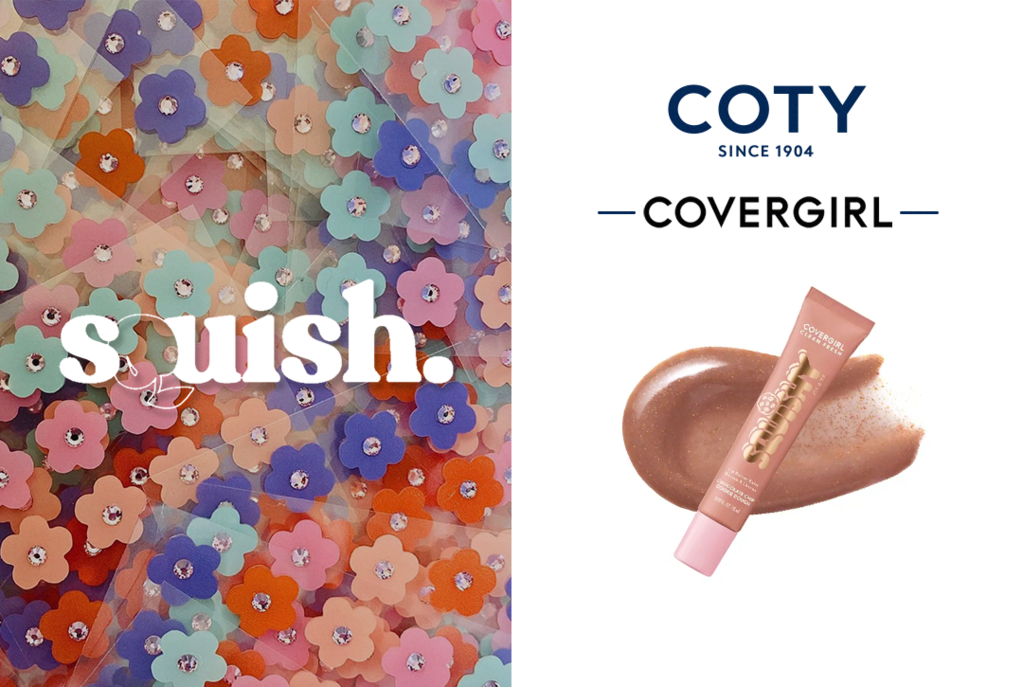
(Left: Squish Beauty's SQUISH branding. Right: CoverGirl Clean Fresh Squishy Glaze. Source: Squish Beauty; CoverGirl)
The path to the SQUISH registration ran through an earlier registration. SQUISHY has been registered to a third party for cosmetics since November 27, 2007 (Reg. No. 3345863), and the USPTO refused Squish's applications on the ground of likelihood of confusion with that registration. According to Coty's motion papers, Squish overcame these refusals on two occasions, in two different ways. In a March 2020 response concerning an earlier application for a stylized SQUISH mark, Squish argued that the marks were "holistically dissimilar, [so] no confusion will occur in the minds of members of the trade and public." For the standard character application that matured into the current registration, Squish filed a consent to registration from the owner of the SQUISHY registration in October 2023. The consent stated that the two marks "have coexisted peacefully" for over three years and "differ sufficiently in appearance, pronunciation, and meaning." Squish had also petitioned the Trademark Trial and Appeal Board (TTAB) to cancel the SQUISHY registration, and it withdrew that petition in December 2023.
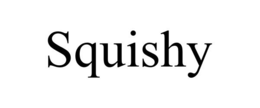
(The third-party SQUISHY mark for cosmetics, registered in 2007 and still in force, Reg. No. 3345863.
Source: USPTO TSDR)
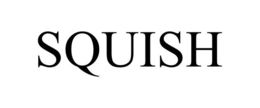
(Squish Beauty's SQUISH mark, Reg. No. 7356905. Source: USPTO TSDR)
Coty's motion to dismiss relies on Squish's own statements to the USPTO
Coty moved to dismiss the complaint on July 7, 2026. Its central argument is that Squish has not plausibly alleged a likelihood of confusion under the Polaroid factors, the multi-factor test that courts in the Second Circuit apply. Coty argues that SQUISH is a weak mark because the word describes the texture of the products and the way a tube is squeezed, and because many SQUISH- and SQUISHY-formative marks coexist on the register for cosmetics. It also argues that the prominent COVERGIRL house mark makes confusion unlikely. On the similarity of the marks, Coty quotes Squish's submissions to the USPTO and states that Squish "has both argued and conceded dissimilarity between SQUISH and SQUISHY."
Squish's two positions give opposite answers to the same question. To obtain its registration, Squish told the USPTO that SQUISH and SQUISHY could coexist without confusion. In this lawsuit, it argues that a product name containing SQUISHY is likely to be confused with SQUISH. An examining attorney deciding whether to refuse registration over a prior mark asks whether the marks, as applied to the goods in question, are likely to cause confusion as to source. A court deciding infringement asks the same question. Both compare the marks in appearance, sound, meaning, and overall commercial impression. For that reason, Squish's earlier statements bear directly on the issue the court must decide.
The earlier statements do not automatically limit Squish's rights. U.S. trademark law has no established counterpart to prosecution history estoppel in patent law that would cut back the scope of a registration because of arguments made during examination, and Coty presents the statements as evidence on the similarity factor rather than as an estoppel. The two inquiries also look at different evidence. Examination compares the marks and goods as they appear in the application and the cited registration, while an infringement court considers how the marks are actually used in the marketplace, so the two need not reach the same result. Even so, a party's earlier contrary statement on the same question is a fact the court can weigh against it, and opposing counsel can be expected to find it. As of November 2026, no ruling on the motion has been reported.
The prior SQUISHY registration matters in this case even though its owner is not a party. Whether CoverGirl's use conflicts with that registration is a separate question that will not be decided here. Within this case, however, the long coexistence of SQUISHY and SQUISH on the register for cosmetics supports Coty's argument that the protection available to SQUISH is narrow. If the dispute escalates, Coty could also counterclaim to cancel the SQUISH registration, which is less than five years old, for example on the ground that the mark is merely descriptive. Squish's prosecution history, including the SQUISHY citation and the consent, would then become part of the record on validity rather than background.
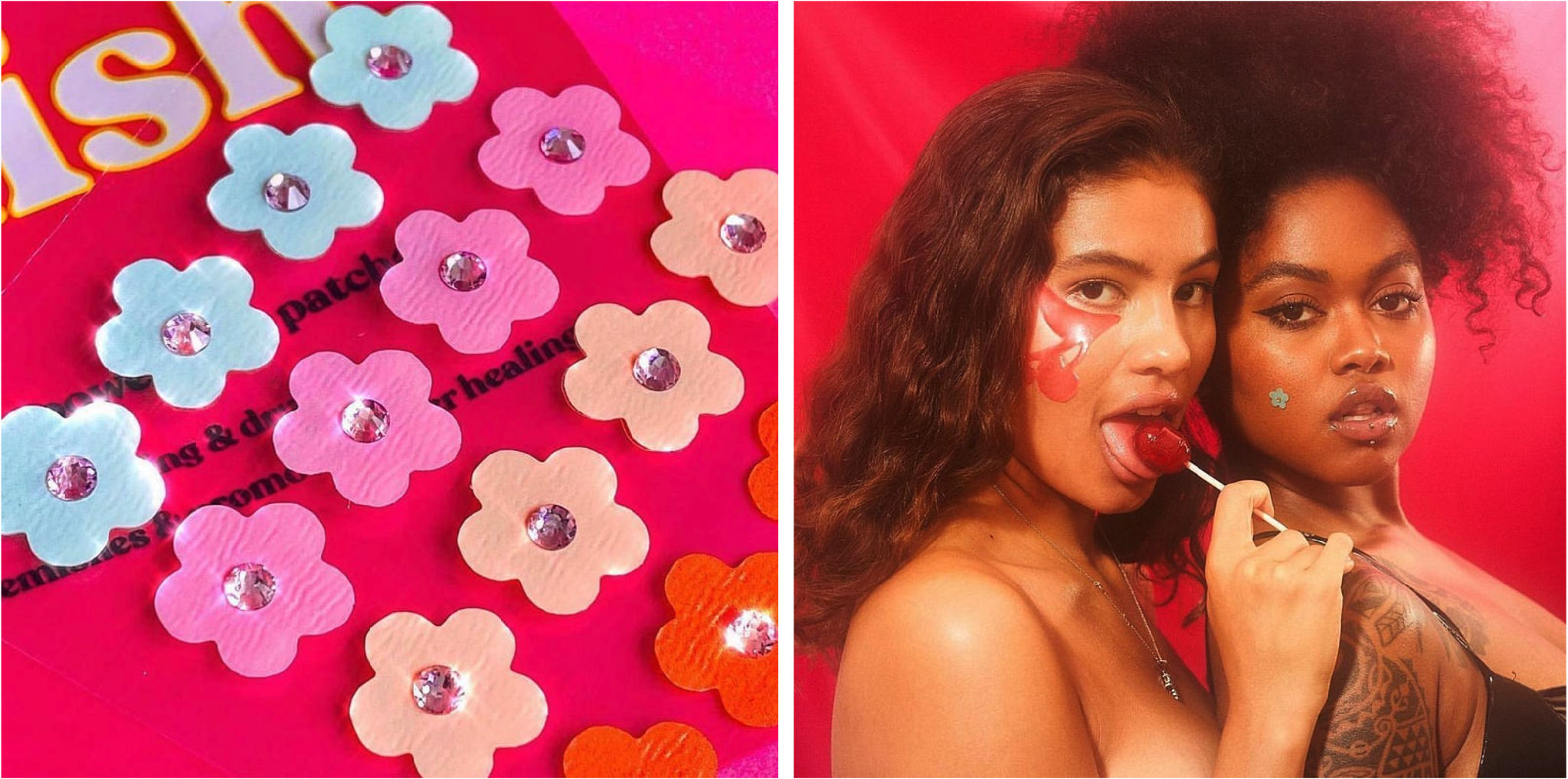
(Squish Beauty's flower-shaped patches and brand imagery. Source: @squish.beauty on Instagram)
In Korea, statements in a written argument are not binding but stay in the record
The same structure arises in Korean practice. When MOIP refuses an application under Article 34(1)7 over an earlier registration, the applicant typically files a written argument explaining why the marks differ in appearance, pronunciation, and meaning. Korean courts apply the same three-part comparison in infringement actions. So does the Intellectual Property Trial and Appeal Board (IPTAB) in invalidation trials and in scope-of-rights confirmation trials. The latter is a Korean administrative proceeding in which the IPTAB determines whether a particular sign falls within the scope of a registered right.
Korean patent law recognizes prosecution history estoppel, under which a patentee cannot reclaim in litigation what it clearly gave up during examination. I have not found an established doctrine of the same kind in Korean trademark law, or a Korean decision treating an applicant's earlier statements as binding on the question of similarity. The court or the IPTAB decides similarity on its own assessment. The written argument nevertheless remains in the prosecution file, which third parties can inspect, and an opposing party can submit it as a circumstance weighing against the trademark owner. In Korean practice, it is not unusual for a brand that obtained registration by strongly arguing dissimilarity from a prior mark to see the opposing party quote that same argument when the brand later challenges a third party's similar mark.
Korea now also offers the route Squish ultimately used. Since May 1, 2024, a proviso to Article 34(1)7 has allowed an application that conflicts with an earlier registration to proceed to registration with the consent of the earlier registrant, except where the marks are identical and the goods are identical. A consent spares the applicant a written argument on similarity. The Squish case shows, however, that a consent does not keep the record free of such statements. The consent Squish filed itself stated that the marks differ in appearance, pronunciation, and meaning, and Coty now quotes that language. When a consent or coexistence agreement is negotiated for a Korean filing, its recitals deserve the same care as a written argument.
What brands filing a similar name in Korea should check
For a brand planning to register a name in Korea that sits close to existing registrations, the Squish case suggests three points to check.
First, choose the response to a refusal with future enforcement in mind. Arguing dissimilarity, amending the designated goods, and obtaining a consent differ not only in cost but also in what each leaves on the record. For a core brand that the company is likely to enforce against similar marks, what it says to obtain registration is part of its brand strategy.
Second, examine the register around the name as a whole. A prior registration cited against your application does not disappear when your registration issues. It continues to define how far your rights can reach, it gives competitors an argument that your name has limited distinctiveness, and in an escalated dispute it can return as a question about the validity of your own registration. If a name was registered alongside an earlier similar mark, the company should assess at the outset how far it can enforce that name.
Third, if the strength of the name may be limited by its prosecution history and the surrounding registrations, build rights beyond the name. Squish complains that CoverGirl copied its look and feel, yet its claims are built on the SQUISH word mark rather than on registered rights in its packaging or product design. In Korea, product shapes and packaging can be protected by design registrations, and visual elements used repeatedly across a brand can be registered as trademarks in their own right.
The Squish case will not be decided soon, but the question it raises can be asked now. Ask yourself how many statements in your brand's prosecution files an opponent could quote in a future lawsuit, and whose earlier rights sit beneath your brand name.
By Karl Taekyun Chung, Partner Attorney
and Head of Strategy, BLT Patent & Law Firm
#Trademark #TrademarkLaw #TrademarkLitigation #TrademarkInfringement #LikelihoodOfConfusion #TrademarkProsecution #OfficeAction #ProsecutionHistory #ConsentAgreement #CoexistenceAgreement #USPTO #KIPO #MOIP #KoreanTrademark #KoreaTrademarkFiling #BeautyBrands #IndieBeauty #Cosmetics #BrandProtection #BrandStrategy #DesignRights #IPStrategy #SquishBeauty #CoverGirl #BLTPatent #KoreanPatentAttorney





When Korea's Ministry of Intellectual Property (MOIP, formerly the Korean Intellectual Property Office) refuses a trademark application over an earlier registration, it does so under Article 34(1)7 of the Korean Trademark Act, broadly the Korean counterpart to a Section 2(d) refusal. The usual response is a written argument that the two marks differ in appearance, pronunciation, and meaning. Once the registration issues, most brand owners treat that argument as a closed matter. A trademark lawsuit now pending in New York shows how such statements can return when the same brand later tries to stop a similar name. Brands registering their names in Korea face the same risk.
Squish obtained its SQUISH registration over a prior SQUISHY registration
Squish Beauty is an independent beauty brand founded in 2019 by the model Charli Howard. Based in Brooklyn, it has built a following on social media with playful products such as jelly lip gloss and flower-shaped acne patches. It owns U.S. Reg. No. 7356905 for SQUISH in standard characters, registered on April 9, 2024, for goods including cosmetics, lip gloss, and skin care patches.
On April 28, 2026, Squish sued Coty, one of the world's largest beauty companies, in the U.S. District Court for the Southern District of New York (Squish Beauty LLC v. Coty Inc., No. 1:26-cv-03503). The target is a lip product that Coty's CoverGirl brand launched in October 2025 as Clean Fresh Squishy Glaze Lip Butter Balm. Squish asserts trademark infringement and unfair competition under the Lanham Act together with claims under New York law, and it points to similarities in fonts, imagery, and packaging to support its allegation that consumers are likely to be confused.
(Left: Squish Beauty's SQUISH branding. Right: CoverGirl Clean Fresh Squishy Glaze. Source: Squish Beauty; CoverGirl)
The path to the SQUISH registration ran through an earlier registration. SQUISHY has been registered to a third party for cosmetics since November 27, 2007 (Reg. No. 3345863), and the USPTO refused Squish's applications on the ground of likelihood of confusion with that registration. According to Coty's motion papers, Squish overcame these refusals on two occasions, in two different ways. In a March 2020 response concerning an earlier application for a stylized SQUISH mark, Squish argued that the marks were "holistically dissimilar, [so] no confusion will occur in the minds of members of the trade and public." For the standard character application that matured into the current registration, Squish filed a consent to registration from the owner of the SQUISHY registration in October 2023. The consent stated that the two marks "have coexisted peacefully" for over three years and "differ sufficiently in appearance, pronunciation, and meaning." Squish had also petitioned the Trademark Trial and Appeal Board (TTAB) to cancel the SQUISHY registration, and it withdrew that petition in December 2023.
(The third-party SQUISHY mark for cosmetics, registered in 2007 and still in force, Reg. No. 3345863.
Source: USPTO TSDR)
(Squish Beauty's SQUISH mark, Reg. No. 7356905. Source: USPTO TSDR)
Coty's motion to dismiss relies on Squish's own statements to the USPTO
Coty moved to dismiss the complaint on July 7, 2026. Its central argument is that Squish has not plausibly alleged a likelihood of confusion under the Polaroid factors, the multi-factor test that courts in the Second Circuit apply. Coty argues that SQUISH is a weak mark because the word describes the texture of the products and the way a tube is squeezed, and because many SQUISH- and SQUISHY-formative marks coexist on the register for cosmetics. It also argues that the prominent COVERGIRL house mark makes confusion unlikely. On the similarity of the marks, Coty quotes Squish's submissions to the USPTO and states that Squish "has both argued and conceded dissimilarity between SQUISH and SQUISHY."
Squish's two positions give opposite answers to the same question. To obtain its registration, Squish told the USPTO that SQUISH and SQUISHY could coexist without confusion. In this lawsuit, it argues that a product name containing SQUISHY is likely to be confused with SQUISH. An examining attorney deciding whether to refuse registration over a prior mark asks whether the marks, as applied to the goods in question, are likely to cause confusion as to source. A court deciding infringement asks the same question. Both compare the marks in appearance, sound, meaning, and overall commercial impression. For that reason, Squish's earlier statements bear directly on the issue the court must decide.
The earlier statements do not automatically limit Squish's rights. U.S. trademark law has no established counterpart to prosecution history estoppel in patent law that would cut back the scope of a registration because of arguments made during examination, and Coty presents the statements as evidence on the similarity factor rather than as an estoppel. The two inquiries also look at different evidence. Examination compares the marks and goods as they appear in the application and the cited registration, while an infringement court considers how the marks are actually used in the marketplace, so the two need not reach the same result. Even so, a party's earlier contrary statement on the same question is a fact the court can weigh against it, and opposing counsel can be expected to find it. As of November 2026, no ruling on the motion has been reported.
The prior SQUISHY registration matters in this case even though its owner is not a party. Whether CoverGirl's use conflicts with that registration is a separate question that will not be decided here. Within this case, however, the long coexistence of SQUISHY and SQUISH on the register for cosmetics supports Coty's argument that the protection available to SQUISH is narrow. If the dispute escalates, Coty could also counterclaim to cancel the SQUISH registration, which is less than five years old, for example on the ground that the mark is merely descriptive. Squish's prosecution history, including the SQUISHY citation and the consent, would then become part of the record on validity rather than background.
(Squish Beauty's flower-shaped patches and brand imagery. Source: @squish.beauty on Instagram)
In Korea, statements in a written argument are not binding but stay in the record
The same structure arises in Korean practice. When MOIP refuses an application under Article 34(1)7 over an earlier registration, the applicant typically files a written argument explaining why the marks differ in appearance, pronunciation, and meaning. Korean courts apply the same three-part comparison in infringement actions. So does the Intellectual Property Trial and Appeal Board (IPTAB) in invalidation trials and in scope-of-rights confirmation trials. The latter is a Korean administrative proceeding in which the IPTAB determines whether a particular sign falls within the scope of a registered right.
Korean patent law recognizes prosecution history estoppel, under which a patentee cannot reclaim in litigation what it clearly gave up during examination. I have not found an established doctrine of the same kind in Korean trademark law, or a Korean decision treating an applicant's earlier statements as binding on the question of similarity. The court or the IPTAB decides similarity on its own assessment. The written argument nevertheless remains in the prosecution file, which third parties can inspect, and an opposing party can submit it as a circumstance weighing against the trademark owner. In Korean practice, it is not unusual for a brand that obtained registration by strongly arguing dissimilarity from a prior mark to see the opposing party quote that same argument when the brand later challenges a third party's similar mark.
Korea now also offers the route Squish ultimately used. Since May 1, 2024, a proviso to Article 34(1)7 has allowed an application that conflicts with an earlier registration to proceed to registration with the consent of the earlier registrant, except where the marks are identical and the goods are identical. A consent spares the applicant a written argument on similarity. The Squish case shows, however, that a consent does not keep the record free of such statements. The consent Squish filed itself stated that the marks differ in appearance, pronunciation, and meaning, and Coty now quotes that language. When a consent or coexistence agreement is negotiated for a Korean filing, its recitals deserve the same care as a written argument.
What brands filing a similar name in Korea should check
For a brand planning to register a name in Korea that sits close to existing registrations, the Squish case suggests three points to check.
First, choose the response to a refusal with future enforcement in mind. Arguing dissimilarity, amending the designated goods, and obtaining a consent differ not only in cost but also in what each leaves on the record. For a core brand that the company is likely to enforce against similar marks, what it says to obtain registration is part of its brand strategy.
Second, examine the register around the name as a whole. A prior registration cited against your application does not disappear when your registration issues. It continues to define how far your rights can reach, it gives competitors an argument that your name has limited distinctiveness, and in an escalated dispute it can return as a question about the validity of your own registration. If a name was registered alongside an earlier similar mark, the company should assess at the outset how far it can enforce that name.
Third, if the strength of the name may be limited by its prosecution history and the surrounding registrations, build rights beyond the name. Squish complains that CoverGirl copied its look and feel, yet its claims are built on the SQUISH word mark rather than on registered rights in its packaging or product design. In Korea, product shapes and packaging can be protected by design registrations, and visual elements used repeatedly across a brand can be registered as trademarks in their own right.
The Squish case will not be decided soon, but the question it raises can be asked now. Ask yourself how many statements in your brand's prosecution files an opponent could quote in a future lawsuit, and whose earlier rights sit beneath your brand name.
By Karl Taekyun Chung, Partner Attorney
and Head of Strategy, BLT Patent & Law Firm
#Trademark #TrademarkLaw #TrademarkLitigation #TrademarkInfringement #LikelihoodOfConfusion #TrademarkProsecution #OfficeAction #ProsecutionHistory #ConsentAgreement #CoexistenceAgreement #USPTO #KIPO #MOIP #KoreanTrademark #KoreaTrademarkFiling #BeautyBrands #IndieBeauty #Cosmetics #BrandProtection #BrandStrategy #DesignRights #IPStrategy #SquishBeauty #CoverGirl #BLTPatent #KoreanPatentAttorney